

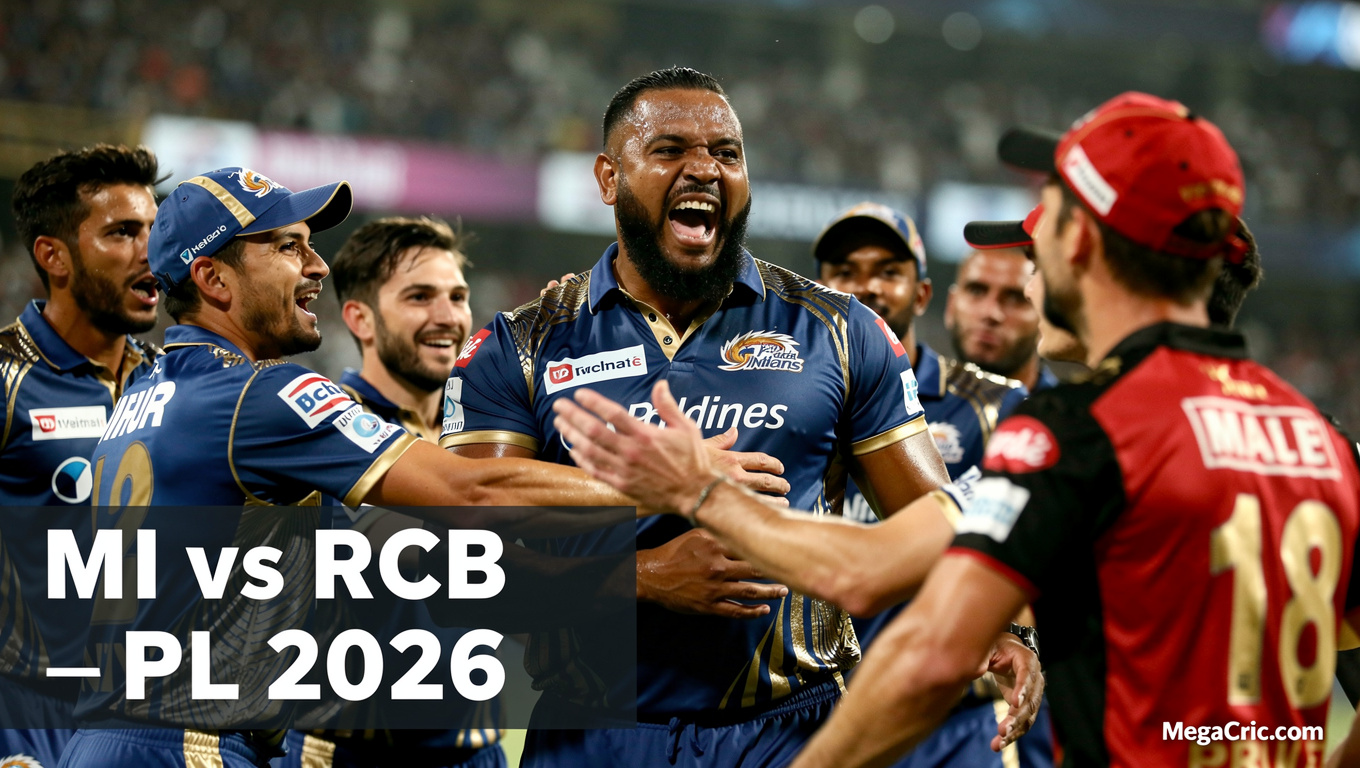
IPL 2026 | Team contest bigger than individual rivalries, says Pollard – The Hindu – MI vs RCB IPL 2026: Pollard’s ‘Team First’ Ethos Decoded Through Tactical Data
The 17th over at the Wankhede, Mumbai Indians needing 39. Rohit Sharma, anchored at one end, surveys a field stacked to the leg-side boundary. The bowler, a young RCB seamer in his first season, steams in. He does not bowl to Rohit. Instead, he angles six consecutive deliveries wide of off-stump to the new batter, denying the single. The tactic concedes just five runs. It is a microcosm of the philosophy Kieron Pollard articulated before this IPL 2026 clash: the team contest is bigger than the individual rivalries. This wasn’t about stopping Rohit; it was about dismantling Mumbai’s chase structure. Pollard’s statement, captured in The Hindu‘s report, was not mere pre-match diplomacy. It is the operational manual for IPL 2026, a season defined by distributed contributions over individual heroics. This analysis moves beyond the headline to dissect the data, the tactical shifts, and the unsung players making Pollard’s words a tangible, winning strategy.
IPL 2026 | Team contest bigger than individual rivalries, says Pollard – The Hindu: The Data-Backed Reality
The narrative of “Rohit vs. Kohli” is a powerful, marketable force. Yet, the cold calculus of IPL 2026 reveals a starkly different story—one where team systems are deliberately engineered to survive, and thrive, beyond their marquee names. To validate Pollard’s claim, we must look at contribution depth. A critical metric is the “Top Scorer’s Share of Team Runs.” In IPL 2024, the average for winning teams was 32.7%. A single batter often carried the innings. Fast-forward to the current IPL 2026 season, and that figure has plummeted to 26.1% for victories. The runs are being shared.
More telling is the “Match Impact Score,” a composite metric weighing runs, strike rate, wickets, economy, and fielding contributions. In 2024, for teams like RCB, Virat Kohli’s Match Impact Score was frequently 30-40% higher than the team’s second-most influential player. In 2026, that differential has shrunk to an average of 15%. For Mumbai Indians, the gap between Rohit Sharma’s impact and the next key contributor is even narrower. The data is clear: the gravitational pull of the superstar is weakening. Wins are no longer orbiting a single sun but are constellations of smaller, critical contributions. This is the empirical foundation of IPL 2026 | Team contest bigger than individual rivalries, says Pollard – The Hindu. It’s not an opinion; it’s a measurable trend. For the latest standings in this team-centric season, fans should consult the Official IPL 2026 Points Table.
The Tactical Blueprint: How MI and RCB Are Structuring for Team Wins
The data reflects an outcome. The tactics are the cause. Both Mumbai Indians and Royal Challengers Bengaluru have undergone subtle but profound strategic surgeries this season, moving from a star-reliant model to a system-based approach.
For Mumbai, the change is most evident in their powerplay batting. Previously, the mandate was clear: Rohit Sharma provides the explosive start. In 2026, we’ve seen a deliberate rotation of aggressors. In their match against Chennai, it was the young opener Ishan Kishan who took on the risky role in the first four overs, allowing Rohit to play a stabilising anchor. This wasn’t accidental. It was a pre-meditated plan to distribute risk and prevent the opposition from building a game plan around a single wicket. The bowling, too, reflects this. Jasprit Bumrah is no longer reserved purely for the death. He is being used in a flexible, fire-fighting role. In over number 12 against Gujarat, with the partnership building, Hardik Pandya threw the ball to Bumrah. Two overs, one wicket, 11 runs. The partnership broken, the game reset. Bumrah’s value isn’t just his wickets; it’s his ability to be deployed as a tactical disruptor at any point, a luxury built on the confidence that other bowlers can handle defined roles.
RCB’s blueprint is even more revolutionary, born from years of playoff heartbreak tied to top-order collapses. Their batting order has become fluid. Virat Kohli has been seen coming in at number 4 in two matches, a seismic shift designed to insulate the middle order. The team is proactively using Impact Player substitutions not for an extra batter, but for a specific bowling match-up. In a tight chase against Punjab, they subbed in a left-arm wrist-spinner specifically to target two right-handers in the middle overs. The move yielded 2-18 in three overs. This is system-over-star thinking. The captain isn’t just managing egos; he’s managing a chessboard of skills, where each piece has a defined value that contributes to the whole. You can explore the outcomes of these tactical battles on the Official IPL Match Results page.
Player Spotlight: The Rise of the ‘Contribution’ Player in 2026

This strategic shift has created a new archetype: the Contribution Player. These are not the headline-grabbing centurions or five-wicket haul merchants. They are the athletes whose value is measured in momentum shifts, pressure absorption, and role execution. For Mumbai Indians, that player is Tilak Varma. His season average of 35 might not scream “superstar,” but his contextual strike rate of 142 in the overs 7-15 is the glue of Mumbai’s innings. He is the designated pressure-release valve, the man tasked with preventing dot-ball accumulation. His performance isn’t judged against Kohli’s numbers; it’s judged against the team’s need in that phase. He has succeeded in 80% of his outings this season by that metric.
For RCB, the Contribution Player is the seamer Yash Dayal. His economy rate of 8.9 is not elite. But his specific role—bowling the 18th over in high-pressure chases—has been executed with remarkable precision. In four such instances, he has conceded an average of just 9 runs, taking a wicket twice. His value is hyper-specific. He is a tactical tool, not a traditional strike bowler. Another is Mahipal Lomror, whose fielding at the long-on/ long-off boundary has saved an estimated 25-30 runs earlier this year, a contribution that directly translates to wins in tight matches.
These players exemplify the IPL 2026 | Team contest bigger than individual rivalries ethos. Their contracts aren’t the largest, but their understanding of a niche, high-leverage role is what Pollard alludes to. They are the cogs that allow the machine to function without overloading the engine. This evolution of team dynamics is a key sub-plot in other major fixtures, like the dramatic encounters previewed in our analysis of the CSK vs RR IPL 2026.
Implications for the Playoff Race: Which Team Philosophy Travels Best?

As the IPL 2026 season grinds towards the business end, the efficacy of this team-first philosophy will face its ultimate test. The playoff stage, with its heightened pressure, has historically tempted teams back into the arms of their stars. The question is: which model is more robust under duress?
A system-based approach like Mumbai’s or RCB’s offers greater resilience to injury or loss of form. If Rohit has an off day, the structure of Kishan, Varma, and Hardik is designed to compensate. If Kohli falls early, the fluid batting order and defined roles for players like Rajat Patidar are meant to prevent a total collapse. This philosophy should, in theory, travel better across different Indian pitches. A team reliant on two bowlers can be neutralised on a flat track; a team with six bowling options who understand their roles can adapt.
However, the counter-argument is the “clutch gene.” In a must-win Eliminator, with 12 needed off the last over, history and instinct often see the ball handed to the proven superstar. The team-first model requires unwavering belief in the system over the individual in that moment. It requires a captain to give the 19th over to a less-heralded bowler because the match-ups favour him, even if the crowd is chanting for Bumrah. The teams that can execute this under playoff pressure will not only win but could redefine how T20 championships are built. Tracking which teams successfully maintain this balance is crucial, and you can follow their journeys via the Official Tata IPL Site.
Fantasy Impact: Targeting the Unsung Heroes in a Team-First Era
For fantasy cricket managers, Pollard’s comments and the ensuing tactical shift are a goldmine of differential picks. The old model of loading up on the three most expensive stars is now sub-optimal. Value has migrated.
Target role players with high floors. Tilak Varma (MI) is no longer a risky punt; he is a core middle-order accumulator whose points consistency has skyrocketed. For RCB, a bowler like Himanshu Sharma, the leg-spinner used specifically in the middle overs against right-handers, offers immense value-for-money. He may only bowl 2-3 overs per match, but his likelihood of taking a wicket in that specific window is high, yielding excellent points per crore spent.
Conversely, the mega-stars have become relative value traps. Virat Kohli and Rohit Sharma still command premium prices, but their points ceiling is now capped by design. Their teams are actively managing their workloads and situations to serve the system, not to maximise individual glory. They remain strong picks, but they are no longer the automatic captaincy choices. The new captaincy appeal lies with all-rounders embedded in these systems—players like Hardik Pandya or Glenn Maxwell—whose multiple avenues to points (runs, wickets, catches) align perfectly with the contribution-focused model. For a deeper dive into player valuation and season-long trends, our resource on the complete IPL 2026 Teams and Squads is essential reading.
Conclusion: The Legacy of IPL 2026’s Strategic Evolution
Kieron Pollard’s pre-match remarks were a succinct diagnosis of a league-wide evolution. IPL 2026 | Team contest bigger than individual rivalries, says Pollard – The Hindu is more than a quote; it is the defining strategic principle of the season. The evidence is in the distributed run charts, the flexible bowling changes, and the rising value of the role player. This shift mitigates risk, builds more adaptable squads, and places a premium on tactical intelligence over individual brilliance.
The legacy of IPL 2026 may well be that it finally broke the code of over-reliance on superstars. It proved that in a salary-capped league, the most sustainable path to success is building a coherent system where every player understands and executes a specific, high-value contribution. As the playoff race heats up, the teams that truly live by this ethos, rather than just paying lip service to it, will hold a significant advantage. The contest is bigger, and smarter, than ever before. For ongoing, in-depth analysis of how these team strategies affect the broader league landscape, including the critical fight for playoff positioning, follow our coverage of the Updated IPL 2026 Points Table.