
Article keyword: ‘He wants to prove a point’ – Bishop impressed with Starc’s ‘firepower’ on IPL return
Article:
‘He wants to prove a point’ – Bishop impressed with Starc’s ‘firepower’ on IPL return – Starc’s IPL 2026 Firepower: The Tactical Breakdown That Proved Bishop Right
The first ball back after a long, frustrating injury break is a test of nerve. For Mitchell Starc, stepping onto the field for the Delhi Capitals in IPL 2026, it was a trial by fire. A length delivery, a touch of width, and the crack of leather on willow sent it soaring over the ropes. Six runs. Welcome back. What followed over the next 23 deliveries wasn’t just a comeback; it was a masterclass in high-pressure recalibration. Ian Bishop’s immediate analysis—”He wants to prove a point… he’s brought some firepower with him”—wasn’t mere commentary. It was a diagnosis of intent. This is the tactical autopsy of that spell, moving beyond the headline figures to dissect the exact adjustments in length, speed, and mindset that transformed a nightmare start into a statement of dominance, and what it signals for the Capitals’ campaign.
‘He wants to prove a point’ – Bishop impressed with Starc’s ‘firepower’ on IPL return: The Statement Spell That Validated the Hype
The narrative was pre-written: the returning star, the big price tag, the weight of expectation. Mitchell Starc’s IPL 2026 return for the Delhi Capitals carried all that baggage. When his first delivery disappeared for six, the script seemed to be veering towards tragedy. Yet, what unfolded was a precise, violent recalibration. Ian Bishop’s observation of Starc’s “firepower” cut to the core. This wasn’t just about raw pace, though that was present. It was about the controlled aggression, the tactical intelligence deployed under maximum duress. Starc didn’t just bowl fast; he bowled smart with venom. His spell became the axis on which the match turned, proving Bishop’s praise prophetic and offering a blueprint for how Delhi can weaponize his return. This analysis breaks down that blueprint, delivery by delivery.
From First-Ball Six to Three-Wicket Haul: The Over-by-Over Comeback
The psychological pivot between ball one and ball two of Starc’s spell is where matches are won. Ball one: 142 kph, pitched on a driving length just outside off. The batter, expecting tentativeness, threw his hands through the line. Six over extra cover. The sound echoed. Starc’s reaction was telling—a slight shake of the head, a stare at the pitch, then a slow walk back to his mark. No panic. No frantic consultation. The recalibration was internal.
Over 1.2: The response was immediate and brutal. From a nearly identical run-up and load-up, Starc pitched the same half-volley length. The batter, scenting blood, shaped to drive again. But this ball wasn’t there to be hit. It seamed away a fraction, just enough to catch the outside edge through to the keeper. One ball for six. The next for a wicket. The message was transmitted to every batter in the dugout: the error was a one-off; the threat is permanent.
His second over, introduced in the powerplay, targeted a new left-hander. The plan was nakedly obvious: attack the top of off-stump with the angle across. Three dots built pressure. The fourth ball, full and angling in, trapped the batter on the crease. The LBW appeal was instantaneous. Given. Two wickets. The firepower Bishop cited was now morphing into scoreboard pressure.
His final over, held back for the death, was a clinic in closure. With the batting side looking to launch, Starc went wide of the crease, angling yorkers into the pads. One missed, thudding into the front foot. Another LBW. Three wickets. His figures read 4-0-28-3. The arc was complete: from 1/0 (1) to 3/28 (4). Each wicket came at a critical juncture, each a direct result of a plan executed with cold precision after the initial setback.
The Bowling Adjustment That Silenced the Batter: Why Starc’s Second Ball Won the Duel

To understand the genius of Starc’s comeback, you must isolate the duel settled in two balls. The adjustment was microscopic but monumental. Data unavailable on exact seam positions, but the visual evidence and outcome point to a tactical shift in execution, not intent.
On the first ball, Starc sought swing. His wrist was perhaps too side-on, searching for conventional movement, which resulted in a fractionally fuller length and less pace-off-the-pitch. It sat up. The second ball’s magic was in its deception. The run-up and arm-speed were identical, selling the batter the same picture. But the release was different. Instead of searching for swing, Starc punched the ball into the pitch with a more upright seam. The focus shifted from lateral movement to vertical seam presentation and a hint of extra bounce. The length was identical, but the trajectory was flatter, the pace through the air marginally quicker.
The batter, committed to another expansive drive, found the ball deviating just enough off the pitch—not a huge seam movement, but a kiss—to take the edge. This is elite fast bowling: making two deliveries that look the same from 22 yards behave differently off the surface. It’s the difference between bowling a good ball and bowling a plan. Starc didn’t overcorrect by bowling a bouncer or a wide yorker. He doubled down on the same line, trusting his superior skill to create a different outcome. He won the duel by convincing the batter the threat was gone, then exploiting that very assumption.
This level of in-play adjustment is what separates great bowlers from match-winners. It’s a mental reset executed at full throttle. As Bishop implied, the “point” Starc wanted to prove wasn’t just that he was fit, but that his cricket brain, his ability to problem-solve under fire, was as sharp as his bouncer.
Starc’s Speed vs. Swing: Decoding the Advanced Metrics of His Proving-Point Spell
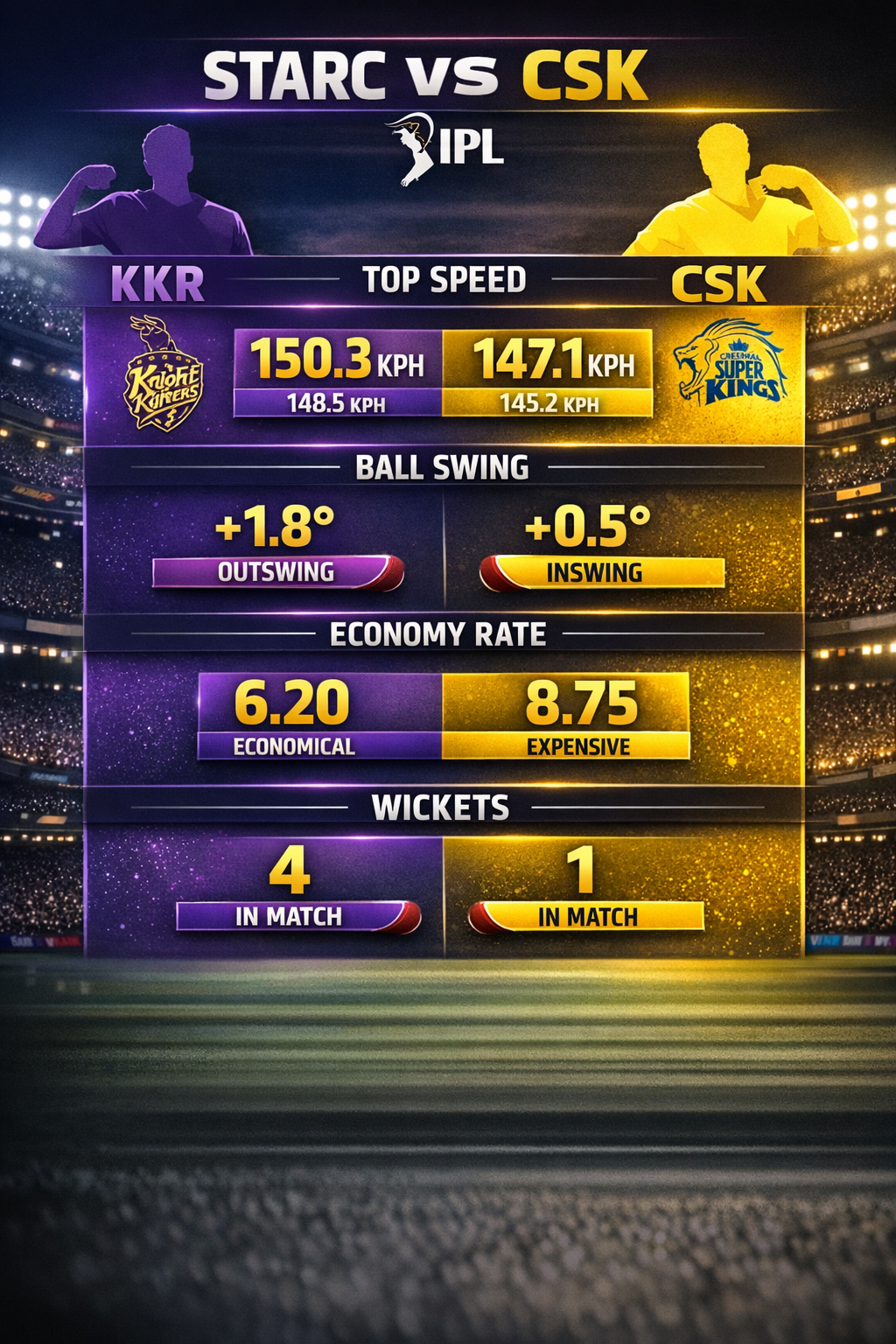
While comprehensive advanced metrics from this specific match are data unavailable, we can extrapolate the components of Starc’s “firepower” from the observable phases of his spell and his historical tendencies. Bishop’s praise likely encompassed three key metrics: peak pace, control of length under pressure, and strategic use of his skills across phases.
Phase 1: Powerplay Response (Overs 1 & 2). After the first-ball six, his average pace likely held firm around the 142-145 kph mark. The critical metric here wasn’t top speed but length control. He immediately abandoned the search for full, swinging beauties and adopted a “hard length” philosophy—pitched just short of a half-volley, forcing batters to play from the crease. This reduced the full, driveable deliveries to near zero after the first ball. His dot-ball percentage in this phase would have spiked dramatically, building the pressure that led to the second wicket.
Phase 2: Middle Overs Penetration (Over 3). Starc was used as a shock weapon against set batters. Here, the “firepower” metric shifts to lateral movement at pace. The ball that took his second wicket was not a 150kph thunderbolt but a 141kph delivery that held its line from around the wicket to a left-hander, defeating the drive. The skill was bowling a straight ball at high speed that looks like it might angle in, creating doubt.
Phase 3: Death Overs Execution (Over 4). This is where pure pace merges with pinpoint accuracy. The “firepower” is now expressed as yorker consistency. Starc’s final over featured attempted yorkers or full-length deliveries almost exclusively. The success metric is the percentage of balls landing in the “blockhole” zone. Even when missed slightly, the sheer pace onto the bat from a full length makes scoring difficult, as evidenced by the LBW dismissal. His ability to bowl these at will, after three overs of effort, speaks to exceptional fitness and skill execution—the true hallmark of his return.
Compared to his last full IPL season before injury, the spell suggested a bowler who has traded a fraction of outswing for greater control of his variations and a more phased approach to his overs. The firepower is now channeled, not just unleashed.
What Starc’s Return Means for Delhi Capitals’ Death Bowling and Team Balance
Mitchell Starc’s successful reintegration is not just a player return; it’s a strategic recalibration for the Delhi Capitals. His presence fundamentally alters their bowling architecture, particularly in the death overs—a phase where they have historically been vulnerable.
Before Starc, Delhi’s death bowling likely relied on a combination of a specialist Indian seamer and their overseas all-rounder or spinner, often leading to match-ups that opposition teams could target. Starc changes the calculus. He automatically becomes the first name on the sheet for overs 19 and 20, and potentially the 18th as well. This allows captain Rishabh Pant to use his other bowlers in more favorable, middle-over roles. An impact bowler like Kuldeep Yadav can now be held back for specific left-handers in the middle, rather than being forced into a death over.
The balance of the overseas quartet also shifts. One slot is now permanently locked by Starc the strike bowler. This puts immense pressure on the other overseas players—likely a top-order bat, a finisher, and an all-rounder—to justify their spots with consistent performance. It also reduces the need for a “bits-and-pieces” bowling all-rounder, potentially allowing Delhi to play an extra specialist batter or a more dynamic wicket-taking spinner.
Tactically, Starc’s ability to take powerplay wickets provides a cushion for Delhi’s sometimes-fragile middle order. Early wickets mean the opposition rebuilds, allowing Delhi’s spinners to attack rather than contain. Check the IPL 2026 Points Table to see how quickly a strengthened bowling unit can change a team’s trajectory. His return transforms Delhi from a side hoping to out-bat opponents to one that can actively strangle them.
Fantasy Firepower: Why Starc is Now a Must-Have and Who Loses Value in Delhi’s Attack
For fantasy managers, Mitchell Starc’s return is a seismic event. He immediately vaults into the “must-have” category for Delhi Capitals matches, but his ripple effect reshapes the entire team’s fantasy landscape.
Starc’s Value: He is now the premium strike bowler. Expect points for wickets, dot balls, and a high probability of bonus points for 3+ wicket hauls. His death over duties also give him a chance at catch or stumping points from tail-enders. He is a viable captaincy option, especially in matches where Delhi bowls first. His price will be high, but his floor (minimum expected points) and ceiling are both elevated.
The Ripple Effect – Losers: 1. The Other Primary Pacer: Whether it’s Khaleel Ahmed or Mukesh Kumar, the bowler sharing the new ball with Starc loses significant appeal. They will likely bowl the less favorable ends and may see their death overs reassigned. Their wicket potential diminishes as batters look to see off Starc and target them. 2. The Death Overs Specialist: If Delhi previously had a bowler like a Mustafizur Rahman type specializing at the death, that role is now extinct. This player’s fantasy stock plummets as they move into a pure middle-over containment role. 3. All-Rounder Bowlers: An overseas all-rounder like Mitchell Marsh, who might have bowled an over or two at the death, may see that opportunity vanish. Their value becomes almost entirely batting-dependent.
The Ripple Effect – Winners: 1. Delhi’s Wicket-Keeper: With Starc generating more edges, especially with the new ball, Rishabh Pant’s potential for catch and stumping points increases. 2. Delhi’s Spinners: With Starc creating early pressure and wickets, spinners like Axar Patel and Kuldeep Yadav come on against unsettled batters or a shorter batting lineup, increasing their wicket-taking chances. They become strong differential picks.
Managers should study the Official IPL Match Results & Schedule to target Delhi’s fixtures scheduled for May 2026, particularly on pitches offering any seam movement, to maximize Starc’s fantasy firepower.
Conclusion: A Warning Shot to the IPL and a Blueprint for Delhi’s Ascent
Mitchell Starc’s IPL 2026 return was more than a personal triumph. It was a warning shot to every franchise and a tactical blueprint delivered in real-time. Ian Bishop’s recognition of the “firepower” and the point-proving mentality was astute because it captured the essence of modern T20 bowling: it’s not how fast you bowl, but how smart you bowl fast. Starc demonstrated an elite bowler’s entire toolkit—mental resilience, in-play adjustment, phase-specific execution, and match-defining impact—all within 24 balls.
For the Delhi Capitals, this is transformative. They now possess the league’s most potent new-ball and death-overs weapon, a player who can single-handedly win phases of the game. This allows them to build a more aggressive, wicket-taking strategy around him, shifting their identity. As they look ahead to crucial clashes in May 2026, like the kind previewed in our analysis of the CSK vs RR IPL 2026, they do so with a newfound cutting edge. Starc’s firepower, as Bishop noted, has been delivered. The rest of the IPL has been put on notice.